








In an era dominated by smartphones, high-speed cellular networks, and satellite internet, two-way radios remain an indispensable tool for communication. From emergency response teams and security personnel to outdoor adventurers and event organizers, these devices provide instant, reliable, and line-of-sight communication when traditional networks fail or prove inefficient.
Understanding how two-way radios work, their main categories, and their practical benefits highlights why this classic technology continues to play a vital role today.
1. How Two-Way Radios Work
Unlike standard broadcast radios (which only receive audio) or mobile phones (which rely on complex cellular infrastructure), a two-way radio can both transmit and receive audio signals directly.
- Push-to-Talk (PTT): The defining feature of a two-way radio is the Push-to-Talk button. Pressing this button switches the device from receiver mode to transmitter mode, allowing the user to broadcast their voice across a specific frequency.
- Channels and Frequencies: Radios operate on radio frequency bands such as VHF (Very High Frequency) and UHF (Ultra High Frequency). Channels allow multiple users on the same frequency to hear and speak to one another instantly.
- Direct Communication (Peer-to-Peer): Most traditional two-way radios communicate directly with each other without needing cell towers, routers, or landlines. As long as two units are within range and tuned to the same channel, they can communicate.
2. Key Types of Two-Way Radios
Two-way radios come in various forms, tailored to different environments and user needs:
(a) Handheld Radios (Walkie-Talkies)
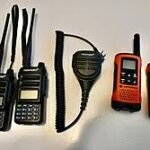
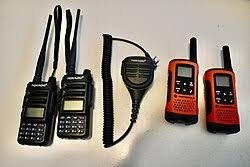
Portable, battery-powered devices designed to be carried by individuals. These range from consumer-grade models used for camping and hiking to heavy-duty professional units used in industrial sites and public safety.
(b) Mobile Radios
Installed inside vehicles such as police cars, fire trucks, delivery vans, and off-road trucks. Mobile radios connect to the vehicle’s electrical power system and external antennas, providing significantly higher transmission power and greater coverage range than handheld units.
(c) Base Stations
Fixed radios set up in an office, dispatch center, or command post. They connect to AC power outlets and high-mounted external antennas to coordinate communication across an entire team or vehicle fleet.
3. Major Advantages Over Smartphones
While smartphones are powerful, two-way radios hold several critical advantages in specific environments:
- Instant Communication: There is no dialing, ringing, or waiting for a connection to establish. A single press of a button broadcasts your message instantly to one person or an entire team.
- Independence from Cellular Networks: During natural disasters, major public events, or in remote wilderness areas, cell towers can become overloaded or go completely offline. Two-way radios operate independently of outside infrastructure.
- Durability and Battery Life: Commercial-grade two-way radios are built to withstand severe drops, dust, water immersion, and extreme temperatures, far outlasting standard smartphones in harsh environments.
- Group Broadcasts: A single transmission can reach dozens or hundreds of workers simultaneously, making them ideal for coordinating large teams at construction sites, festivals, or logistics hubs.
4. Frequency Bands: VHF vs. UHF
Choosing the right two-way radio often comes down to selecting between two primary frequency bands:
- VHF (Very High Frequency): Operates on lower frequencies (typically 136–174 MHz). VHF signals travel farther outdoors over open land, water, or rolling hills with few obstacles. They are commonly used in aviation, marine navigation, agriculture, and outdoor recreation.
- UHF (Ultra High Frequency): Operates on higher frequencies (typically 400–512 MHz). UHF waves are shorter and better at penetrating obstacles like concrete walls, steel structures, and dense wood. As a result, UHF is the standard choice for indoor use, construction sites, manufacturing plants, and urban areas.
5. License-Free vs. Licensed Radios
Depending on the region, using certain radio frequencies requires an official license:
- License-Free Radios (e.g., FRS / PMR446): Designed for consumers and light business use. These radios operate on pre-assigned low-power channels and do not require user licenses, making them easy to buy and use right out of the box.
- Licensed Radios (e.g., GMRS, Business Bands): Designed for professional applications requiring higher power, longer range, and private channels. Obtaining a license ensures that businesses can operate on assigned frequencies without interference from nearby users.
Conclusion
Two-way radios continue to prove that specialized, dedicated technology often surpasses multi-purpose devices in critical situations. Whether keeping workers safe on high-risk job sites or maintaining a lifeline in the deep wilderness, two-way radios remain a cornerstone of fast, dependable, and durable communication.