






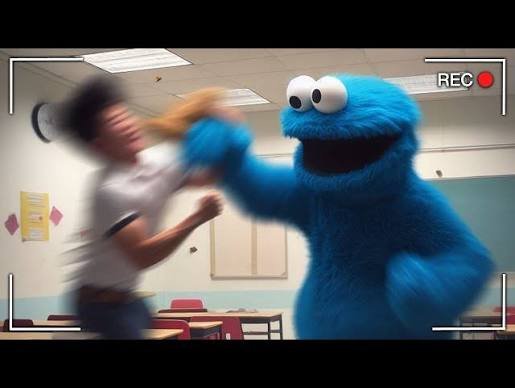
Artificial Intelligence (AI) has sparked a massive revolution in the world of image generation and digital art. With advanced AI image generators like Midjourney, DALL-E, and Stable Diffusion, anyone can now create breathtaking visuals simply by typing a few words (prompts). However, alongside this cutting-edge technology, a strange, fascinating, and unsettling trend has emerged across the internet: “Cursed AI Images.”
These are images that appear unnatural, surreal, bizarre, or downright terrifying. They are not the result of a human artist’s intentional composition; rather, they are born from an AI algorithm’s misinterpretations, visual confusions, or technical processing errors.
But what exactly are Cursed AI images? Why do they happen? And why have they captured such a massive footprint in modern internet culture? Let us explore this phenomenon in depth.
1. What Are Cursed AI Images?
In internet slang, the word “cursed” refers to anything that feels deeply unsettling, wrong, or psychologically disorienting. When an AI fails to comprehend a prompt or stitches together visual patterns incorrectly, the resulting image often looks like a scene straight out of a fever dream or a nightmare.
These images typically feature:
- Distorted Human Anatomy: Figures rendered with extra fingers, misplaced eyes, or faces that appear to melt into their surroundings.
- The Uncanny Valley Effect: Depictions that look almost human, yet contain subtle, unnatural flaws that trigger an immediate sense of unease in the viewer.
- Dream Logic: Visual scenarios where the laws of physics and spatial reality cease to exist—such as floating architectural walls or objects seamlessly bleeding into one another.
2. Why Does AI Generate Cursed Images? (Technical Reasons)
AI image generators operate on machine learning and deep learning models. These systems are trained on billions of image-text pairs from across the web. When you feed a prompt into an AI, it does not simply copy-paste existing pictures; instead, it uses learned statistical patterns to “denoise” a brand-new image from scratch. Several technical limitations cause this process to go awry:
(a) Lack of Spatial Awareness and Physics
AI models lack a fundamental understanding of how the physical world operates. An AI knows that a “hand” is associated with “fingers,” but it does not intrinsically understand that a human hand strictly has five fingers. Consequently, it often renders hands with six, seven, or strangely fused digits.
(b) Conflicting Prompts
When a user asks the AI to combine two vastly different or contradictory concepts, the algorithm attempts to blend their visual features. If the prompt lacks clear boundaries, the AI makes flawed assumptions, leading to bizarre hybrid results.
(c) Denoising Artifacts and Glitches
Modern Diffusion Models begin the generation process with random visual noise (pixels) and iteratively refine it into a clear picture. If this iterative process strays off course due to complex prompts, the image retains strange visual artifacts, warped textures, and incomplete structures.
3. Common Categories of Cursed AI Images
Cursed AI images found online generally fall into several distinct visual tropes:
- Anatomical Glitches: The most famous examples involve human faces and hands. Common tropes include smiling faces with far too many teeth, eyes placed where noses should be, or limbs bent at impossible, bone-breaking angles.
- Surreal Hybrid Creatures: Occurs when the AI merges two distinct animals or fuses human features with inanimate objects—such as rendering human eyes on a cat or generating entirely unrecognizable biological entities.
- Glitched Text and Symbols: Text inside AI-generated images often manifests as unreadable, alien-like glyphs (pseudotext) that resemble cryptic or ominous runes.
- Impossible Architecture: Structures featuring doors opening into empty ceilings, staircases leading nowhere, or room walls melting into furniture with impossible perspectives.
4. Their Role in Internet Culture and Memes
Far from being dismissed as mere technical failures, cursed AI images have become a core pillar of modern internet culture and meme communities.
- Social Media Hubs: Platforms like Reddit, X (formerly Twitter), and Instagram host dedicated communities (such as r/cursedimages or r/weirddalle) where users share the most absurd and unsettling AI outputs.
- Dark Comedy and Humor: Internet users frequently pair these bizarre visuals with sarcastic or observational captions, transforming technological blunders into viral comedy.
- Inspiration for Surreal Art: Many digital artists, game developers, and horror writers actively study cursed AI images to draw fresh inspiration for cosmic horror, surrealism, and abstract monster designs.
5. Will Cursed AI Images Ever Disappear?
As generative AI models continue to evolve rapidly with newer iterations, models are becoming significantly better at understanding human anatomy, hand structures, and spatial geometry. As a result, unintentional anatomical glitches are becoming much less frequent.
However, users now intentionally craft complex, surreal, or contradictory prompts specifically to force the AI into outputting cursed visuals. Therefore, regardless of how hyper-realistic AI technology becomes, “Cursed AI Art” will remain a permanent and intentional subculture on the internet.
Conclusion
Cursed AI images represent a fascinating, unexpected side-effect of modern artificial intelligence. They serve as a vivid reminder that no matter how sophisticated algorithms become, they still lack genuine human cognition and real-world comprehension. Rather than simple mistakes, these glitches have evolved into a brand-new form of digital surrealism—one that continues to mesmerize, disturb, and entertain audiences worldwide.